
 Italiano
 Français
 Deutsch
 Español

News
Shanling SM50: guide to streaming, connections and headphone listening
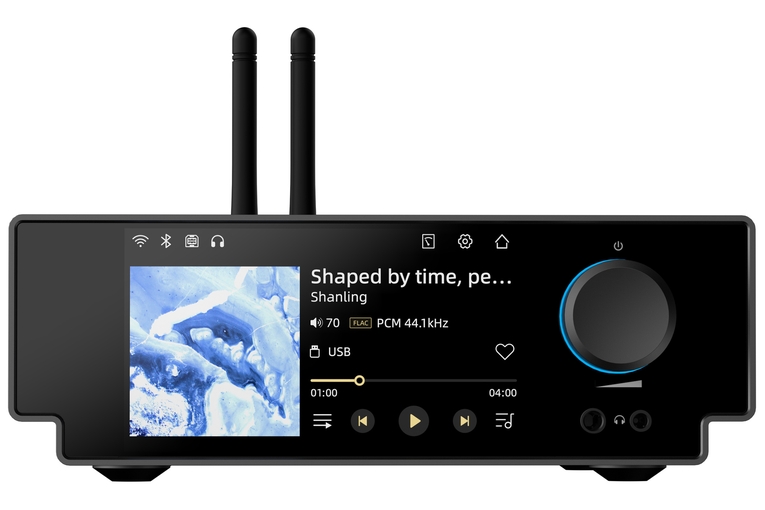
Shanling SM50 is a compact network streamer designed to combine several digital playback functions in a single unit: access to streaming services, playback of local files, digital-to-analog conversion, connection to a HiFi system and direct headphone listening. The Linux-based system, ESS ES9039Q2M DAC and presence of analog and digital connections allow it to be integrated into different configurations.
The choice should therefore be evaluated starting with the type of system you want to create. SM50 can function as a source connected to an amplifier, as a control center for a desktop system or as a unit for headphone listening. Actual compatibility always depends on the inputs available on the other components, the home network and the devices used for streaming.
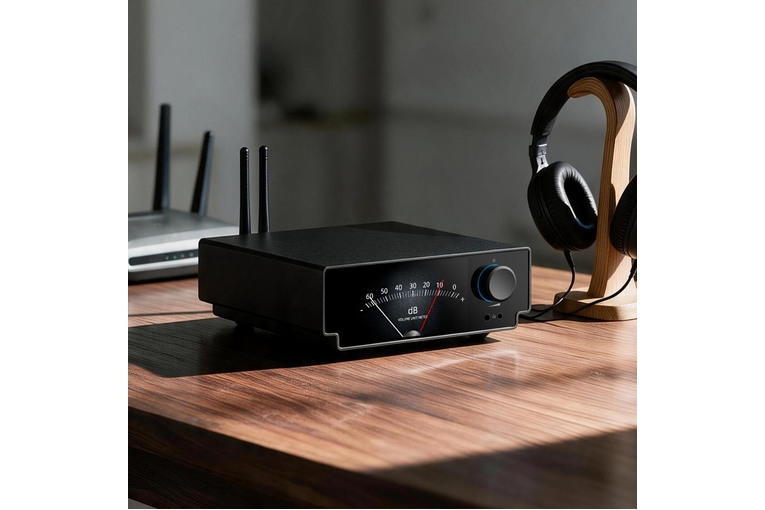
What is Shanling SM50
SM50 is a desktop music streamer with an integrated DAC and headphone outputs. The device uses a Linux-based operating system and can be controlled via the integrated touchscreen or the Eddict Controller app. The display measures 4.5 inches and has a resolution of 1080 × 1920 pixels, also indicated as 1080p.
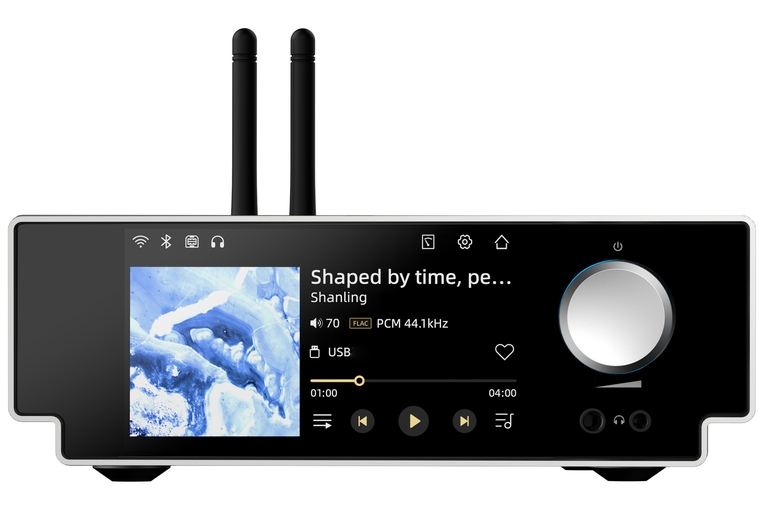
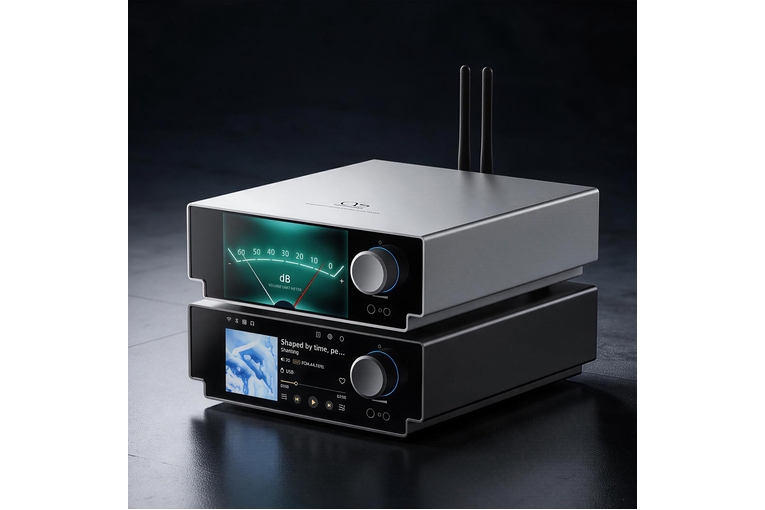
The declared dimensions are 20.5 × 18.8 × 5.3 cm. The aluminum chassis is completed by glass panels; Black and Silver finishes are available. The compact structure makes it easy to integrate into a desktop system or a HiFi rack, while still leaving the space required for cables and ventilation.
Streaming, network and local playback
Network connection can be established via Ethernet or dual-band Wi-Fi. This choice between two options makes it possible to select either a wired connection, useful when the router or local network is close to the system, or a wireless solution for installations offering greater freedom of placement.
Supported services and environments include Tidal Connect, Qobuz Connect and Roon Ready. SM50 is also compatible with DLNA, AirPlay 2 and Squeezelite and can access content stored on a NAS. The most suitable method depends on how your library is organized and which platforms you already use.
For local playback, a USB drive can be connected. Files can be selected from the touchscreen or via Eddict Controller. Local playback supports PCM files up to 32 bit/768 kHz and DSD512, according to the data declared for this mode. Final compatibility also depends on the file format and the drive used.
Which mode to choose
- Streaming services: suitable for those who use Tidal Connect, Qobuz Connect or a Roon system.
- NAS: suitable for those who keep their music library on the home network.
- USB drive: useful for playing local files without relying on a network archive.
- AirPlay 2, DLNA and Squeezelite: offer additional ways to send and manage compatible content.
DAC and analog connections
Digital-to-analog conversion is handled by the ESS ES9039Q2M DAC. Analog outputs include one pair of RCA and one pair of XLR outputs, both configurable in Line-Out or Pre-Out mode. This distinction is important when choosing the connection.
Line-Out mode is intended to send a line-level signal to an amplifier with its own volume control. Pre-Out mode, on the other hand, allows SM50 to manage the level sent to the connected component, according to the configuration intended for the system. Before installation, it is therefore advisable to check which unit will receive the signal and which component will control the volume.
RCA and XLR do not represent two modes that must necessarily be used together: the choice depends on the inputs available on the amplifier or other elements in the chain. The presence of both connections facilitates integration with systems using different configurations.
Headphone listening: 4.4 and 3.5 mm
SM50 has two headphone outputs: a balanced 4.4 mm output and a single-ended 3.5 mm output. This dual provision allows headphones or cables with different terminations to be used without necessarily resorting to adapters.
Declared power reaches up to 700 mW at 32 ohms from the balanced 4.4 mm output in high gain mode. For the 3.5 mm single-ended output, power of up to 182 mW at 32 ohms is specified. High gain and low gain modes are also available. These values alone do not determine compatibility with every headphone: impedance, sensitivity, cable termination and desired listening level must also be considered.
To choose the correct output, it is necessary to check the headphone connector. The 4.4 mm balanced connection requires a compatible termination; adapters without the correct electrical characteristics should not be used. The 3.5 mm output is single-ended and intended for headphones or cables with the corresponding connector.
Digital outputs and USB DAC input
In addition to the analog outputs, SM50 provides a USB digital output and an SPDIF coaxial output. These connections allow the signal to be sent to a DAC or another component equipped with the corresponding digital input, leaving conversion to the latter.
A dedicated USB DAC input is also provided. In this configuration, SM50 can receive the digital signal from, for example, a compatible computer and handle it according to the USB DAC mode provided by the device. It is important to distinguish this input from the USB and coaxial digital outputs: the former receives the signal, while the latter send it to an external unit.
Bluetooth and everyday use
Bluetooth 5.2 is specified as a Bluetooth input and supports the LDAC and aptX HD codecs. To use these codecs, the transmitting device must also support them; otherwise, the connection will use the compatible profile provided by the source.
The touchscreen allows information to be viewed directly on the unit, while Eddict Controller adds control from a mobile device and management of the local library. This combination is useful in a desktop system, where front-panel control can be alternated with app-based control.
Who might benefit from Shanling SM50
- Those looking for a compact music center: it combines streaming, USB playback, a DAC and headphone listening.
- Those who own an amplifier or active speakers: the RCA and XLR outputs allow the connection to be selected according to the available inputs.
- Those who use headphones with different terminations: both balanced 4.4 mm and single-ended 3.5 mm outputs are provided.
- Those who want to retain an external DAC: the USB and SPDIF coaxial outputs allow the digital signal to be sent to a separate component.
- Those who alternate between network sources and local files: streaming services, NAS, network protocols, Bluetooth and USB drives are available.
Compatibility: checks to perform before connecting
Before integrating SM50 into a system, it is useful to check four elements. The first is the network: you need to decide whether to use Ethernet or Wi-Fi and make sure that the NAS, router or chosen service is configured correctly. The second concerns volume control: Line-Out or Pre-Out mode should be selected according to the connected component.
The third element is the destination of the digital signal. If USB or SPDIF is used toward an external DAC, check that the DAC input is compatible with the selected connection. Finally, for headphone listening, it is necessary to check the connector, impedance and sensitivity of the model being used, without considering the power figure alone as a sufficient criterion.
In summary
Shanling SM50 is a versatile digital source, with features aimed at both HiFi systems and personal listening. The ESS ES9039Q2M DAC, RCA and XLR outputs, support for Tidal Connect, Qobuz Connect, Roon Ready, DLNA, AirPlay 2, Squeezelite and NAS, together with USB playback and Bluetooth 5.2, allow it to address different needs.
Its key design strength is the ability to choose its role within the chain: analog source, preamplifier, digital transport or headphone unit. Choosing the correct configuration requires only an orderly check of the inputs, outputs, home network and characteristics of the connected headphones or amplifier.